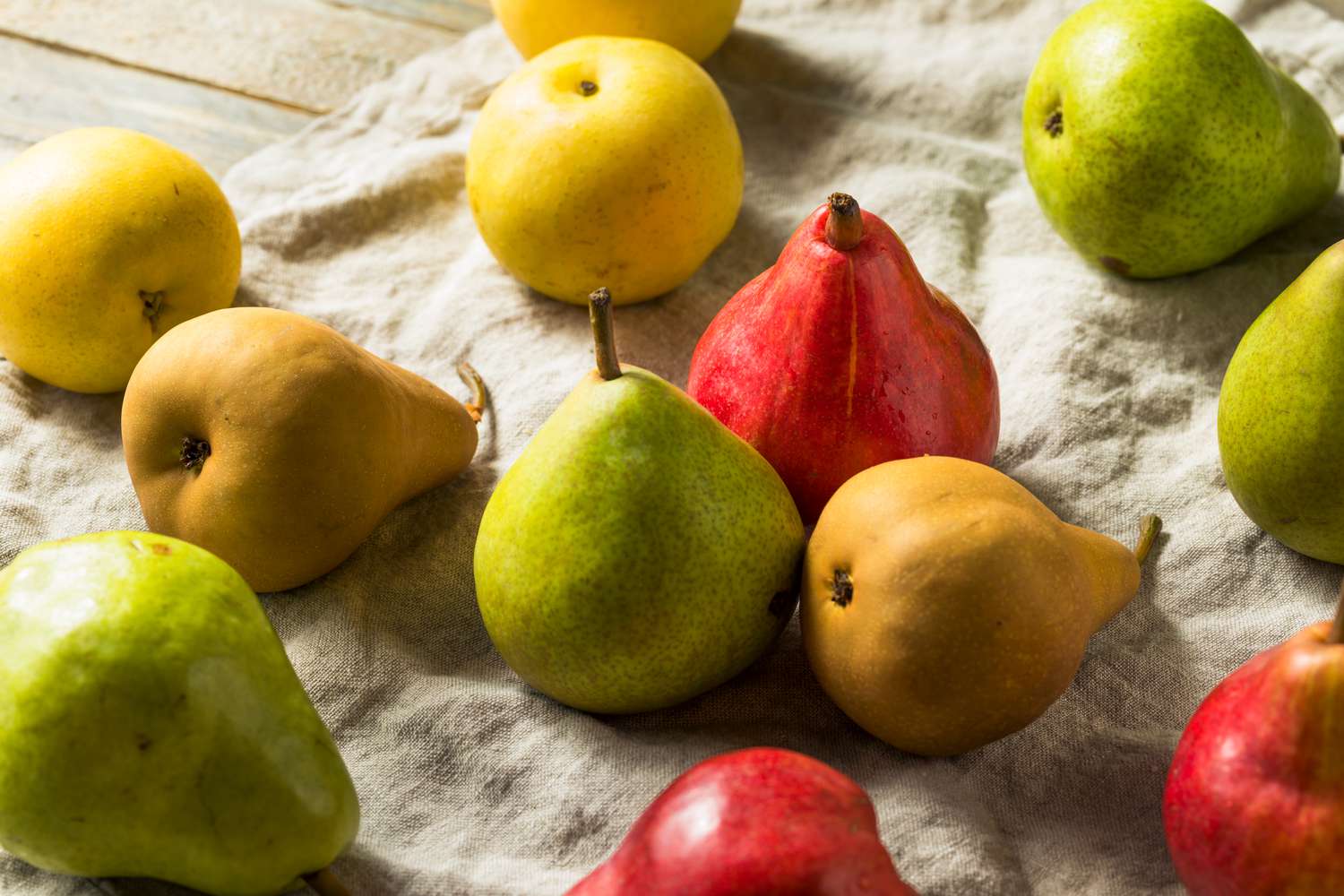
by Anna Nelson – Your grocery store carries two pears. Maybe three if it’s a good one. Bartlett, Bosc, and a bin of green Anjou that’s been there since August. Our pear list is longer, because nothing on it has to survive a cross-country truck. Bartlett, Bosc, Comice, Seckel, Warren, Niitaka, Hosui, Shinseiki, and 20th Century, depending on what the orchards have each year.
It’s easy to think of a pear as one thing. A green fruit, sort of sweet, sometimes gritty, usually a little disappointing. That’s the pear most of us grew up with. But a pear isn’t one fruit. It’s a big family with a lot of cousins, and right now a bunch of them happen to be showing up at the same time.
The world’s pear collection lives in Oregon
Here’s something I didn’t know until I went looking. The USDA runs a gene bank in Corvallis, a few hours north of us, and it holds the world’s pear collection. More than two thousand trees. Wild pear species, heirloom varieties nobody grows commercially anymore, cider pears from England, Asian cultivars, rootstocks. Seeds and cuttings from over fifty countries, all kept alive in one orchard.
They put it there on purpose. Pears do well in this part of the world. They want warm days and cool nights, and they need a real winter to set them up for spring. They also tolerate heavy soil and wet weather in a way that stone fruit just won’t. Peaches sulk here. Pears don’t.
Growers in the Rogue Valley figured this out a century ago. Apples were the big crop through the early 1900s, and then most of that acreage got pulled and replanted in pears, because the warm days, cool nights, and clay soil suited pears better. The pear is Oregon’s state fruit now. The state ranks second in the country for production, behind Washington.
Ours come from closer than Corvallis. The Bartlett, Bosc, Comice, Seckel and Warren are grown around Roseburg, in the Umpqua Valley, where the summers get hot and the nights cool down hard. The Asian pears are grown in Smith River and Langlois, right in our backyard. Same two counties. Same fog.
 Three pears, three accidents
Almost every pear you’ve eaten traces back to a tree somebody stumbled on.
The Bartlett is the big one. Sometime around 1765, an English schoolmaster named John Stair found a pear seedling growing on his property in Berkshire. Nobody planted it. He liked the fruit, a nurseryman named Williams got hold of it, and it spread across England as the Williams pear. Cuttings came to Massachusetts in the 1790s. A man named Enoch Bartlett bought the property, had no idea the tree already had a name, and introduced it under his own. It took thirty years for anyone to realize the Williams and the Bartlett were the same pear.
Here’s the part I like. Pears don’t come true from seed, so every named variety is propagated by grafting. That means every Bartlett tree on earth is a cutting taken from a cutting taken from a cutting, going back to that one seedling in Stair’s yard. When you eat a Bartlett, you’re eating fruit off a tree that’s been alive, in pieces, for two hundred and sixty years.
The 20th Century pear has a better story. In 1888, a thirteen-year-old farm boy in Japan named Kakunosuke Matsudo spotted a scrappy little seedling growing in a relative’s garbage dump. He dug it up and planted it in his family’s orchard. It took ten years to fruit. When it finally did, the pears were sweet and crisp and better than anything else around. He spent years getting it into other people’s hands. It became the most planted pear tree in Japan. The Hosui on the site is descended from it, so two of the four Asian pears we’re carrying trace back to a kid and a trash heap.
Then there’s the Warren. It was found in a yard in Hattiesburg, Mississippi, in the 1970s by a fruit collector named T.O. Warren. The flesh has no grit cells at all, which is unusual. Buttery, silky, sweet with a little spice to it. It’s considered one of the best eating pears there is.
You’ve almost certainly never seen one in a store. It doesn’t ship well, the fruit comes in uneven sizes and shapes, and it isn’t a reliable enough producer for commercial packing. So it lives in home orchards and on small farms, and it reaches you through something like Otterbee’s or it doesn’t reach you at all. That’s a real category of food, and it’s easy to forget it exists.
The fruit you have to finish yourself
Pears are the odd one out. Most fruit ripens on the tree. Pears don’t, or rather they shouldn’t, because they ripen from the inside out. Leave one on the branch and the core turns mealy before the outside ever softens. That grainy, cottony pear you had once and never forgot? That’s what happened.
So growers pick them firm and mature, and the last step is yours. Leave them on the counter at room temperature, not in the fridge. Then check the neck. Press the narrow part near the stem with your thumb. When it gives a little, it’s ready. Don’t wait for the fat part to soften, because by then you’ve missed it.
Bartletts tell you outright. They go from green to clear yellow. Bosc and Warren won’t change color much, so the neck is all you’ve got. If you want to speed things up, put them in a paper bag with a banana or an apple for a day or two. The bag traps the ethylene the fruit gives off and the pears soften faster. Check them daily, because the window is short. Once one is ripe, the fridge will hold it a few more days.
Asian pears skip all of this. They ripen on the tree and arrive ready. Crisp when you get them, crisp two weeks later in the crisper drawer. You just eat them.
What to do with seven pears
Start by eating a couple plain, cold, standing over the sink. Especially the Warren. That one deserves to be tasted by itself before it goes into anything.
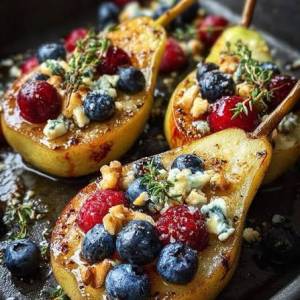 Bosc is the baker. It’s dense and it holds its shape, so it won’t collapse into mush. Halve them, core them, and roast cut side down in butter until the edges brown. Poach them in cider with a cinnamon stick and a strip of lemon peel. Slice them onto a sheet pan with red shallots and a little olive oil and roast until both go sweet and sticky, then pile that over pork or a pan of greens.
Bartlett is the raw, soft one. Juicy, classic, a little floral. It’s what you want sliced onto toast with cheese, or chopped into a crisp with oats and brown sugar. Overripe Bartletts are not a complete loss. Cook them down with a splash of water into a loose sauce and eat it on yogurt all week.
Asian pears want to stay crunchy, so treat them more like an apple. Shred one into a cabbage slaw with lime and a little fish sauce. Slice one thin over a plate of kale with toasted walnuts. Grate one into a marinade for beef, which is a Korean trick and a good one, because the fruit tenderizes the meat while it sweetens it. Niitaka runs large and mild. Shinseiki and 20th Century are bright and yellow-skinned. Hosui is the russet brown one and the sweetest of the bunch.
And if you want to see where the whole family ends up, there’s quince paste on the site too, made in Smith River. Quince is a pear relative, hard and useless raw, transformed by long slow cooking into something you slice thin and eat with cheese.
None of this is a one-time shop. It’s the stretch of the year when the fruit bowl stays full on the counter and you check it every morning on the way to the coffee. Buy a few of each. Let them come along at their own pace. The farms that grow these have picked them at the right moment and sent them a short distance, and the last little bit of the work is yours.
Anna Nelson is a writer and editor based in Smith River, CA. She writes about local food and seasonal shifts and is a proud OtterBee’s shopper and contributing author to the OtterBee’s Market blog.