
by Anna Nelson – I’ve had a carton of goumi berries sitting in my fridge for a few days now. At first, I figured I’d make jam. That’s where most people’s heads go with a tart fruit they’re not totally sure about. But jam takes time and requires a certain amount of commitment to the project. So I kept opening the fridge and eating a small handful instead. Tart, a little sweet, that bright red juice on my fingers. And I started thinking about what else they could do.
Turns out, quite a lot.
Most people who’ve heard of goumis at all think of them as a jam fruit or a snack. And they’re great for both. The flavor is somewhere between a sour cherry and a red currant, with a little earthiness underneath and a brightness that lingers. Raw, they have a pleasant pucker that mellows as they ripen. But here’s the thing about that tartness: it’s exactly what makes them useful in a savory kitchen, too. That quality that makes you reach for another handful is the same quality that makes a sauce sing. It cuts through fat. It lifts heavier flavors. It does what a squeeze of lemon or a splash of vinegar does, but with more depth and a little more personality.
Most people just don’t think to use them that way. This post is an invitation to try.
A fruit that knows its way around a dinner plate
Think about how you use other tart fruits in cooking. Cranberries alongside a roast. Cherries in a pan sauce. A spoonful of jam stirred into a braise. Those aren’t dessert moves. They’re cooking moves, and they work because fruit and fat have always gotten along. Goumis fit right into that tradition.
The simplest place to start is a pan sauce. After searing a steak from Oat Hill, pour off most of the fat and toss a small handful of goumis into the hot pan with a splash of broth and a sprig of thyme. Let it all bubble together for a few minutes, pressing the berries gently with a spoon as they soften. Once they’ve broken down, pour the sauce through a fine-mesh strainer, pressing the solids to get everything out. What comes through is a smooth, dark-red sauce that coats the back of a spoon. The pits and skins stay behind. The fat left in the pan smooths out the tartness, and the berries leave behind something fruity and savory at the same time. It takes about ten minutes and uses up maybe a quarter of your carton.
 Lamb works beautifully with goumis too. Riyescott Ranch lamb has enough richness to stand up to a more assertive preparation. Try a slow braise with a cup of goumis, a few garlic cloves, a sprig of rosemary, and enough red wine to come halfway up the meat. The berries mostly dissolve over a couple of hours, leaving the braising liquid a deep, slightly tangy purple. Nothing about it tastes fruity in a precious way. It just tastes like a really good braise, with a little something extra you can’t quite name.
For fish from Fishermen’s Direct, the approach is lighter. Simmer about a cup of goumis with a minced shallot, two tablespoons of honey, and a splash of apple cider vinegar over medium heat. Stir occasionally and let it cook down for ten to twelve minutes until the berries are completely soft. Press everything through a fine mesh strainer to remove the pits and skins, then return the liquid to the pan for another minute or two if you want it a little thicker. Season with a small pinch of salt. Spoon it warm or at room temperature over grilled salmon, albacore, or lingcod.
And for something that requires no cooking at all, toss a small handful of raw goumis into a green salad with sliced cucumber, crumbled feta or goat cheese, and toasted walnuts or hazelnuts. Just treat them the way you’d treat an olive. Eat around the pit or give guests a heads-up. They pop when you bite into them, which is half the fun, little bursts of tart juice against the creaminess of the cheese and the crunch of the nuts. Dress it simply, just olive oil and a pinch of salt. The goumis do most of the work.
A short season worth paying attention to
The window for all of this is short, which is worth saying plainly. Goumis ripen in late spring and early summer, ahead of most other berries. When blueberries are still a few weeks out and the early strawberries are just wrapping up, goumis are already here. They’re one of the first fruits of the season, and they don’t linger. A carton in your fridge is good for maybe four or five days before the texture starts to soften past the point you’d want to eat them raw. Cook them sooner rather than later if you’re planning anything beyond snacking.
That urgency is part of what makes them feel special. There’s no waiting for the right moment. The right moment is now, while they’re sitting in your fridge looking at you.
Why a farm would choose to grow them
 Part of why goumis show up at Otterbee’s at all comes down to the kind of farm that grows them, and the kind of thinking that goes into choosing what to plant.
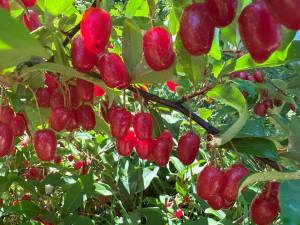
Goumi shrubs are nitrogen-fixing plants. That’s not a marketing term. It describes something real that happens underground. The roots of the plant form a relationship with soil bacteria that converts atmospheric nitrogen into a form the soil can actually use. Nitrogen is one of the things plants need most to grow, and most conventional farms supply it through synthetic fertilizers. Goumi shrubs do it for free, just by being in the ground. Over time, the soil around them gets richer, not poorer.
For a small farm growing multiple crops on the same land, that matters. A goumi shrub planted near a vegetable bed or alongside an orchard row is actively improving the conditions for everything around it. It doesn’t need much tending once established. It handles poor soil and doesn’t require chemical inputs. It produces fruit for years. And when you harvest that fruit, the plant keeps working. The bees that pollinate the small, fragrant goumi flowers move on to whatever’s blooming nearby. The leaf litter feeds the soil. Nothing about the plant is extractive.
That’s a different calculation than growing a single high-yield crop that depletes the land and requires constant inputs to keep going. Small farms on the Southern Oregon and Northern California coast often can’t afford to farm that way anyway, and many of them don’t want to. The ones that supply Otterbee’s tend to think in terms of the whole system, the whole piece of land, over many seasons. Goumis fit that way of thinking.
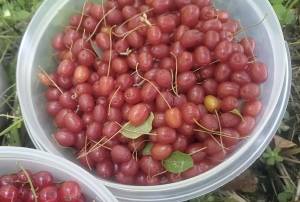 They also don’t scale well, which is exactly why you won’t find them at a chain grocery store. The harvest window is too short. The fruit is too fragile. The volumes are too small to justify the refrigerated transport and long shelf-life requirements of conventional retail. Which means that if you want them, you basically have to know someone who grows them, or shop somewhere that does the work of connecting those dots.
That’s what Otterbee’s is for.
My carton has maybe two more good days left in it. Tonight I’m making that pan sauce with an Oat Hill steak and whatever greens are left in the crisper drawer. Tomorrow, if there are any left, I might try the relish with fish. And if I’m being honest, I’ll probably eat a handful straight out of the container while I’m deciding.
That’s the thing about goumis. You keep meaning to do something impressive with them, and then you just eat them instead. Both outcomes are fine.
Anna Nelson is a writer and editor based in Smith River, CA. She writes about local food and seasonal shifts and is a proud OtterBee’s shopper and contributing author to the OtterBee’s Market blog.