
by Anna Nelson – Here’s something that surprises people. Plant a seed from your favorite apple and you won’t grow that apple.
You’ll grow something else. Maybe small and sour. Maybe, once in a great while, something wonderful. Each seed comes from a blossom that a different tree pollinated, so it gets a mix of two parents, and nobody knows how the mix will turn out.
That’s a problem if you want a Gravenstein, for instance. It was first described in 1797, and it’s still on our tables. So somebody found a way around the gamble.
Where good apples come from
To see how, it helps to meet John Chapman. You know him as Johnny Appleseed, though the real man was more businesslike than the cartoon. He was born in Massachusetts in 1774 and walked west in his twenties with seeds gathered from Pennsylvania cider mills. He planted nurseries along rivers, ahead of the settlers, and sold the young trees when families arrived. Some land deals back then required settlers to plant apple trees to prove they meant to stay, so he had steady customers.
But he was planting seeds, and you know what that means. Many of his trees bore small, tart apples, fine for hard cider and not much else. Settlers who wanted good eating apples often carried cuttings from back east and grafted them.
Chapman’s seedlings were good enough for what settlers needed most, which was trees in the ground and cider in the barrel. But if you wanted a particular apple, one you’d already tasted and loved, a seed could never promise it. To get that apple again, you had to copy the tree itself.
Grafting is how you do that. You cut a twig, called a scion, from a tree whose apples you love, and join it to the roots of another tree, called the rootstock. The twig grows into a new tree that gives you the same apple. Not a cousin. The same one. That’s how a Gravenstein from 1797 can still be sitting in your fruit bowl. Every one is a cutting from a cutting from a cutting.
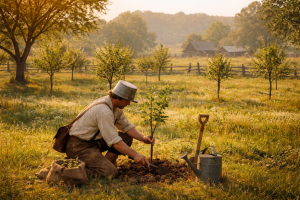 Which brings us back to Chapman, and why he still matters. He didn’t hand us the apples we eat today. Much of what he grew went into cider barrels. What he did was plant seeds in large numbers across a huge stretch of frontier, and every one of those trees was a new roll of the dice. Most rolls came up sour. Once in a while, one came up sweet. That’s how a lot of our best apples got their start: a surprise tree that somebody noticed and had the sense to graft. Granny Smith began as a chance seedling in Australia. So did Braeburn in New Zealand and Cameo in a Washington orchard. Closer to home, Hudson’s Golden Gem was discovered in Oregon in the early 1900s, and Chehalis turned up north of the town of Chehalis, Washington. Seeds make the new apples. Grafting keeps them. Chapman was the seed half, on a scale that’s hard to picture.
So every good apple you eat is a survivor. First a lucky surprise, then a cutting somebody kept alive.
Because the roots and the top are separate, you can even graft several varieties onto one rootstock. Some nurseries sell these as family trees, one trunk with a summer apple on one branch and a winter keeper on another. It takes some pruning to keep a bossy branch in line, but it’s a smart idea for a small yard.
A few survivors worth knowing
The orchards we buy from, in Roseburg, Langlois and Smith River, grow more varieties than any of us could keep straight, and what we have changes every few weeks. The good news is you don’t try to learn them all. Start with a few and see what you like.
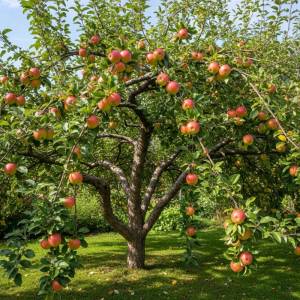 Gravenstein is the old one, crisp and honey-scented, and people around here swear by it for sauce. It’s a summer apple, so use it soon. Jonathan comes from New York, 1862, crisp and juicy, and it keeps well. Cox’s Orange Pippin is sweet with a little tang, and it’s not a storage apple, so eat it soon after picking. Gold Rush comes later in the season, sweet-tart and juicy, and it stays crunchy for a long time. That’s the one to buy a big bag of and tuck away.
Saving a variety is one job. Growing it well is another, and you’ll see two labels on our apples that speak to that. The Roseburg apples are IPM-grown, which stands for Integrated Pest Management. It’s a way of farming, not a certification. The grower learns how the pests in an orchard live and move, keeps a close eye out, and chooses the gentlest fix that works. The Smith River apples take a different road. They’re Registered Organic in California, a program built for small growers. And the Langlois apples are different still – grown using organic practices, just not certified. Different routes, but in all, someone is paying close attention to what goes on the tree.
How to pick a good one
Once you’ve chosen a variety, there’s the apple itself. Hold it. A good one feels firm all over and a little heavy for its size, with tight, smooth skin. Skip anything with soft spots or dents. Smell it, too. Ripe apples smell sweet and fruity, and one that smells like nothing may not be ready. Look at the color under the red. A greenish background usually means it needs more time, and cream or yellow means it’s ready. Freckles, rough patches, and lumpy shapes are fine. Some of the best old varieties are homely.
Lehne Farms in Roseburg lets their apples ripen on the tree, so what shows up at your door is meant to be eaten. At home, keep them cold, in the crisper if you can, and away from other produce. Apples give off a gas that speeds up ripening in whatever’s nearby.
Into the kitchen
Once there’s a bag of apples on the counter, they can do a lot more than pie. Here are two recipes I love for something different with apples.
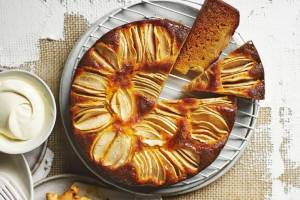 The first is a ginger and apple kuchen from Delicious magazine in Australia. Kuchen is the German word for cake, but it means a particular kind. I lived in Germany as a child and have fond memories of warm, homemade appel kuchen from my German babysitter when I arrived home from school each day. Think of a tender, buttery cake, closer to a coffee cake than a birthday cake, with apples baked into it or on top. As it bakes, the apples soften and give their juices to the crumb underneath. This one adds ginger, which brings a peppery warmth so the cake doesn’t taste only sweet. It’s the cake to bake on a gray Sunday, when the apples arrived on Saturday and the house could use something that smells good. A slice with hot coffee is plenty, and a spoonful of whipped cream (or vanilla sauce, if you want authentic German) doesn’t hurt. Pick an apple that holds its shape in the oven. Jonagold is great for cooking, and Granny Smith stays firm when baked.
The second one makes people look twice: Japanese beef curry with apple in it, from Tiffy Cooks. Japanese curry is comfort food, thick and savory with a gentle sweetness, spooned over rice. You brown chunks of beef and cook a few sliced onions until they go soft and golden. Then everything simmers in water for about an hour, with potatoes and carrots joining halfway. Near the end, a quarter of an apple, grated, goes in with a little coconut milk, a couple of pieces of dark chocolate, and a box of Japanese curry cubes. Apple, chocolate, and coconut milk are what Tiffy calls her three secret ingredients. Here’s my hook. Nobody at your table will say “I taste apple.” They’ll just ask what makes it so good. The apple rounds off the spice and gives the sauce some body. A Jonathan or a Gravenstein, which both cook down easily, is a good pick. The recipe makes about eight servings and takes an hour and a half. It’s better the next day, so it’s made for a Sunday pot and a Monday lunch. You’ll find the curry cubes at an Asian market, and we have beef in the Meat & Seafood section.
That’s how a bag of apples stretches from one week to the next. The list keeps moving. Summer apples like Gravenstein give way to the fall ones, and then to the storage apples, Fuji, Golden Delicious, and the old striped Red Delicious, which is a very different fruit from the one many of us grew up with. Our Tuesday email usually says which apples are coming, so you can plan around them.
I like to stock a kitchen the slow way. Buy a pound or two of whatever’s new. Taste it. Turn the ones that won’t wait into sauce. Save the Gold Rush for January, when a fresh apple from your own cold crisper is a real treat. By the time winter settles in, you’ve eaten your way through the whole season, and you know exactly which ones you’ll be ordering again.
An apple grown in this part of the world doesn’t have far to travel, and that’s part of why it tastes the way it does. It also keeps your dollars with the families who tend these orchards. Orders go in Tuesday or Wednesday, and delivery is Saturday. Hope you drop by and get your fill of apples this season!
Anna Nelson is a writer and editor based in Smith River, CA. She writes about local food and seasonal shifts and is a proud OtterBee’s shopper and contributing author to the OtterBee’s Market blog.