
Something Sweet from Down the Road
by Anna Nelson – Most people walk past membrillo without knowing what it is. The name sounds fancy. The jar looks a little mysterious. But once you try it, you’ll probably wonder why it took you so long.
Membrillo is quince paste. Meaning, it’s literally paste made out of the quince fruit. Quince looks like a cross between a pear and an apple, and it has been around for a very long time. The fruit was first cultivated about 5,000 years ago in Mesopotamia, then spread along ancient trade routes westward into the Middle East and the Mediterranean. By the time the Greeks got hold of it, quince had taken on a kind of mythic status. Ancient Greeks called it “the golden apple” and linked it closely to Aphrodite, the goddess of love and beauty. It was a symbol of fertility and appeared in wedding rituals. Some historians believe the famous “golden apple” thrown into the feast of the gods by the goddess of strife, the one that set off a chain of events leading to the Trojan War, was actually a quince. That’s a lot of weight for one piece of fruit.
The first written recipe for quince paste appears in a Roman cookbook from the 5th century AD, made with honey instead of sugar. From there, it spread across Europe (pun intended), picking up different names in every country it landed in. The word ‘marmalade’ traces back to the Portuguese word for quince paste. The English eventually borrowed it for citrus preserves and the quince connection got lost along the way. In Spain, it became dulce de membrillo. In France, cotignac. In Germany, quince cheese. Every culture that encountered it figured out pretty quickly that it was worth keeping around.
The version we carry at Otterbee’s comes from Smith River Organic Farm. They follow a traditional recipe, slow-cooking organic quince with cane sugar, lemon juice, and a touch of vanilla. No preservatives. No shortcuts. Just four ingredients and some patience. The result is a deep, jewel-toned paste that’s sweet up front with a pleasant tartness underneath.
What It Tastes Like and How to Use It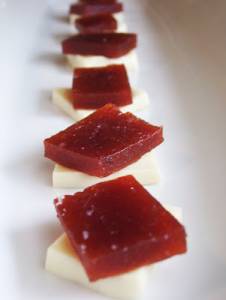
It’s hard to describe membrillo if you haven’t tried it. Think somewhere between a firm jam and a jelly-fruit candy. Dense and smooth. The flavor is sweet and tangy, a little floral, and it has a richness that regular jam doesn’t quite have.
The classic move is to spread it on crackers with aged cheese. The pairing of membrillo with Manchego is a staple in Spanish tapas, and there’s a reason it’s stuck around. The sharpness of an aged cheese and the sweetness of the paste play off each other really well. But you don’t need to stop there. Try it alongside cured meats, tucked into a grilled cheese, or spooned over a simple baked brie. It works anywhere a tart jam would. Thin it out with a little warm water and it makes a decent glaze for roasted pork or chicken thighs.
 I tried ours on crackers with cheese and liked it immediately. It was sweet and tangy, and had this satisfying thickness that felt more substantial than jam. I could see using it in all kinds of ways. My favorite discovery in drafting this article is a Membrillo and Cheese Pastry. That is next on my to-be-baked list. Who wants to come over and try it with me?
A Note on Texture
Because this is a small-batch, preservative-free product, the paste can firm up or crystallize a bit after sitting in the fridge for a while. That’s completely normal. It’s the same thing that happens with raw honey. Just let it sit out on the counter for a few minutes, or give it a very brief warm-up in a bowl of warm water. It’ll loosen right back up and be easy to spread again. No need to worry about it.
Store it in the fridge once opened, and use it within six months. That’s plenty of time to find a lot of good uses for a 4-ounce container.
Local and Worth It
Smith River Organic Farm is just a short drive away, right near the Oregon border. The farm grows organic produce and makes their products in small batches using ingredients you can actually read. That matters. When you buy something like this, you’re not just getting a good condiment. You’re supporting a small operation doing things the slow, careful way.
Membrillo isn’t something you’ll run through quickly. A jar lasts, and that’s part of the appeal. You pull it out for a cheese board, use a little with dinner, maybe introduce a friend to it. It becomes one of those things you just keep on hand. Pick one up next time you’re filling your Otterbee’s cart. It’s the kind of thing that’s easy to love once you actually try it.
Anna Nelson is a writer and editor based in Smith River, CA. She writes about local food and seasonal shifts and is a proud OtterBee’s shopper and contributing author to the OtterBee’s Market blog.