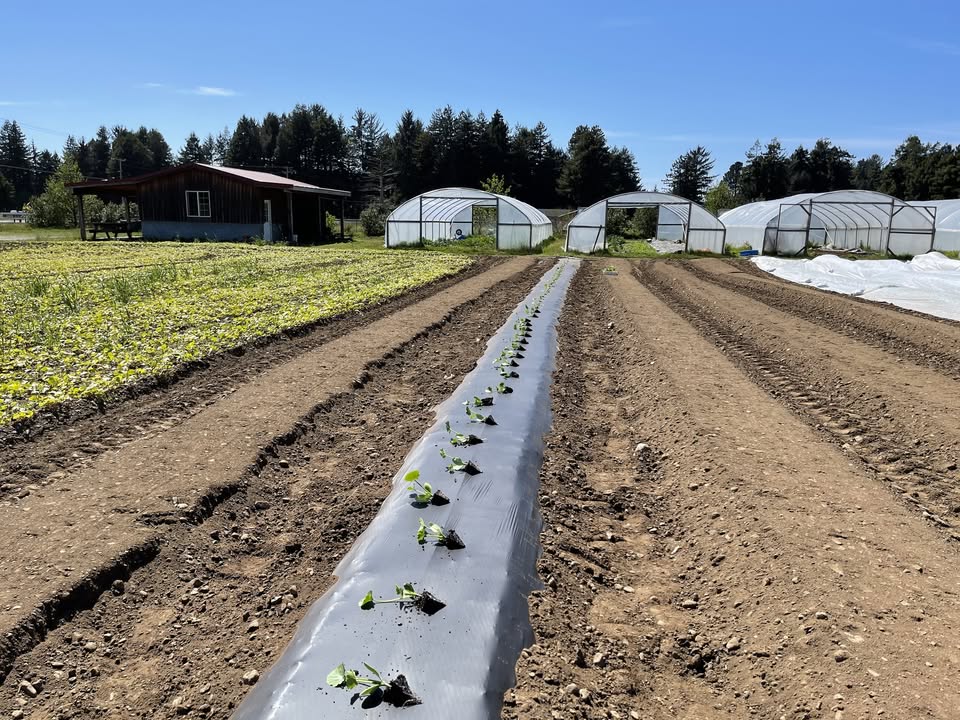
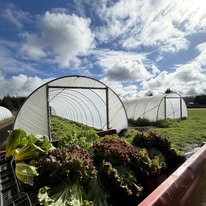
by Anna Nelson – If you drive out toward Fort Dick on a foggy morning, you’ll pass a stretch of old sheep pasture that’s been turned into something else entirely. Rows of greenhouses. A wash station. Animals wandering near a barn. This is Ocean Air Farms, and it didn’t start out looking like this at all. It started with a leaky travel trailer, a dog, and five acres nobody else wanted.
Their produce will be up on our site and available to order in the next few weeks, so we wanted you to know who’s behind it.
How Two Farmers Ended Up in Del Norte County
Paul and Julie Jo met in Arcata, back when they were both just starting to fall into sustainable farming the way people sometimes fall into the thing that ends up defining their whole life. Julie Jo had finished an internship on a nearby farm and was running a community farm called the Arcata Educational Farm. Paul was working hourly on an established farm and had already started his own small CSA on the side.
Here’s the detail we love. Paul found an acre lease on a property that happened to share a fence line with Julie Jo’s educational farm. He had access to a tractor. Her farm had a composting toilet. That’s it. That’s the whole reason two people who’d go on to run a fifteen-acre operation ended up meeting in the first place. Farming has a way of working like that. It’s practical before it’s romantic.
Julie Jo grew up on a family farm in Iowa, so this was always going to be her life in some form. Paul got hooked during college, almost by accident, and never really unhooked. Together they moved up to Del Norte County knowing exactly nobody. Just the trailer, the dog, and five acres of old sheep pasture that hadn’t grown anything but sheep in a long time.
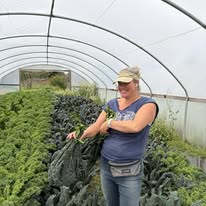 From there it was garlic first, then greenhouses, then a barn, then running water, then a wash station. Then more acres. Then more and more vegetables. That’s not a metaphor, that’s just the literal order things happened in. You build a farm the way you build most things worth having: one exhausting, unglamorous piece at a time.
What They’re Actually Growing
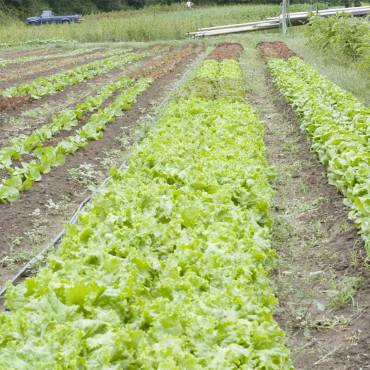
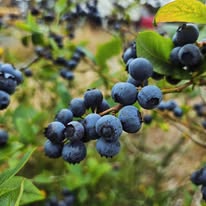
Ocean Air Farms grows close to thirty types of organic vegetables, which is a lot of variety for a fifteen-acre farm to carry well. They also keep a mix of animals, a few fruit crops, and some flowers, though vegetables are clearly the heart of the operation. This is the kind of diversified farm where the crop list reads differently in June than it does in September, and that’s exactly the point. You’re not getting one thing done really well. You’re getting a farm that’s built to feed people through most of the year.
They sell direct at two farmers markets in Crescent City each week, plus operate a farm stand at their own property on Moorehead Road that’s open seasonally. And to Otterbee’s, of course. Around here you’ll also find their produce at Wild Rivers Market and on menus at various local restaurants. That’s a real local footprint. When a farm shows up on that many plates and that many market tables, it usually means the food is doing the talking.
 Why We’re Excited to Carry Their Stuff
With organic vegetable farms this size, the produce tends to have more personality than what you get from a big operation. Carrots with a little more snap. Greens that wilt faster because there’s nothing sprayed on them to slow that down, which sounds like a downside until you realize it just means eat them soon, they’re that fresh.
As you start to see them on our website again over the next few weeks, the timing should line up with the kind of vegetables that make early summer cooking easy. Think quick sautés, simple salads, things you can throw together after work without a recipe in front of you. Nothing fussy. A vegetable that’s good enough on its own doesn’t need much done to it. A little olive oil, some salt, maybe a squeeze of lemon, and you’re done.
What This Means for Your Kitchen
Part of what we like about building Otterbee’s with farms like this one is what it does over time, not just in one order. You pick out exactly what you want, whether that’s a few things or a full week’s worth of vegetables, and we’ll bring it to you on Saturday. That’s a good rhythm to fall into. You stop planning meals around what a recipe says you need and start planning around what’s actually in season that week. It’s a more flexible way to eat, and a lot less wasteful, since you’re choosing what you actually want instead of working through a box of whatever showed up.
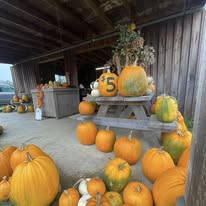 Paul and Julie Jo have been building this farm one wash station and one greenhouse at a time for years. It seems right that we take a minute to introduce them properly. If you want to see the farm and the people behind it, they’re active on Instagram and Facebook, and their farm stand out on Moorehead Road is worth a visit if you’re ever out that way on a Saturday.
Anna Nelson is a writer and editor based in Smith River, CA. She writes about local food and seasonal shifts and is a proud OtterBee’s shopper and contributing author to the OtterBee’s Market blog.