by Anna Nelson – Along the Southern Oregon Coast, where the fog rolls in slow and the air smells faintly of salt and earth, there’s a rhythm that shapes how things grow. You can feel it in the pace of the tides and in the steady hum of small farms that tend this stretch of coastline. One of those is Octopus Herb Garden, a Langlois-based apothecary and herb farm run by Sarah and Allen, a husband-and-wife team whose work captures the quiet balance of this place.
They’ve built something remarkable in its simplicity: a small-batch herbal business that’s part kitchen, part medicine chest, and entirely grounded in care. The name “Octopus” fits. Like the creature itself, their work reaches in many directions, growing, blending, infusing, and crafting, but always with a single purpose: to create herbal remedies and teas that connect people to the living landscape around them.
From Hawaii to Langlois: The Roots of a Coastal Apothecary
 Before the coasts of Oregon, there was the warm air of Hawaii. That’s where Sarah and Allen first fell in love with herbalism — the practice of working with plants as both food and medicine. After nearly a decade of growing, studying, and crafting herbal remedies there, they brought their vision north and planted it in the coastal soil of Langlois. The result is a farm and apothecary that bridges two Pacific worlds: island and coast, tropical and temperate, both united by respect for the ecosystems that sustain them.
Their process is as intentional as it gets. Every herb used in their products is either organically grown by them, ethically wildcrafted, or purchased from other small farms that share their regenerative and sustainable values. The scale is small on purpose to honor the connection between land, plant, and person. You can see it in their rows of lemon balm and thyme, smell it in the peppermint drying on a line, and taste it in the deep floral sweetness of their honey-based remedies.
Their workshop sits close enough to the ocean that you can hear the waves on a still day. It’s a fitting backdrop for their approach: calm, deliberate, and rooted in cycles rather than schedules. Each jar, each pouch of tea, is an invitation to slow down and take part in that rhythm.
Sweet Immunity and the Art of Everyday Herbalism
Among the many treasures Sarah and Allen craft, the one turning heads at OtterBee’s this season is their Sweet Immunity Electuary, a traditional herbal remedy with deep roots in old-world medicine. The word electuary might sound like something from a centuries-old apothecary shelf, but it’s really quite simple: powdered herbs mixed with honey to create a thick, flavorful paste. Octopus Herb Garden’s version blends raw local Oregon honey with orange peel, hibiscus, camu camu, rosehip, and rose powder, a combination packed with Vitamin C and bursting with sweet-tart flavor.
A small spoonful stirred into warm water becomes an instant tea, rich and fragrant. Add it to a smoothie, swirl it into oatmeal, or just enjoy it straight off the spoon. (Some folks even use it as a gentle exfoliating face mask, a testament to how fluid the line can be between nourishment and care.) Whatever way you take it, it’s comfort in a jar. The kind that soothes the body and feels a little like sunshine on a gray coastal morning.
That blend of utility and delight runs through all of Octopus Herb Garden’s creations. Their loose-leaf herbal teas are crafted with the same thoughtfulness:
- “Sweet Dreams,” a gentle, floral nighttime blend to calm the mind and settle the day.
- “Calm Tummy,” a smooth, minty infusion that reminds you how simple herbs can ease what’s been overcomplicated.
- “Tulsi Rose,” bright and balanced, pairing the grounding power of holy basil with the soft, uplifting scent of rose.
Each tea tells its own story of plants grown in fog and sunlight, harvested by hand, and blended in small batches along a stretch of coast that still prizes quiet craftsmanship. Brewed slowly, they feel like part of the weather itself.
The Heart of Small-Batch Work
What stands out about Octopus Herb Garden isn’t just its coastal setting or even its commitment to organic growing. It’s the way the work feels personal. You can sense it in the way Sarah and Allen talk about their craft: the hands-on harvests, the rows of herbs swaying in the ocean breeze, the careful labeling of each jar at the kitchen table. There’s an intimacy there that can’t be scaled up, the kind that comes from years of doing something because you love it, not because you’re chasing volume.
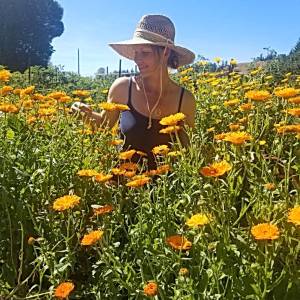 That’s what gives their products a quiet strength. In a world that’s always rushing, their teas and remedies remind us to return to a slower, steadier rhythm. When you scoop a teaspoon of Sweet Immunity into your mug, you’re taking part in a chain of care that begins in the soil, moves through the hive, and ends in your hands. The pace is different here, more deliberate, and that difference carries through in every taste and texture.
This isn’t “local” as a buzzword; it’s local as a lived experience. People shaping their days around plants, and plants shaping those days right back. It’s a kind of work that keeps human hands in the process, preserving the knowledge that good things take time and that the best flavor, like the best medicine, can’t be rushed.
And that may be what draws so many of us to farms like this one. It’s not only about sustainability or food miles or any of the data points we use to justify our choices. It’s about trust — the quiet assurance that someone grew, blended, and bottled something with intention. Something honest. Something that tastes like care.
So as Octopus Herb Garden joins the OtterBee’s family, it feels less like adding a new vendor and more like welcoming a kindred spirit. Their herbs, teas, and remedies speak the same language as this coast: patient, fragrant, and deeply alive. Add one of their teas or a jar of Sweet Immunity to your next OtterBee’s order, and take a moment to slow down with it. Let the honey dissolve, breathe in the steam, and taste what happens when people and place are truly in sync.

